the Good news of Reformation Day
Thank you to Rev. Austin Pfeiffer who delivered this chapel message on November 1, 2024. We hope it encourages our whole school community!
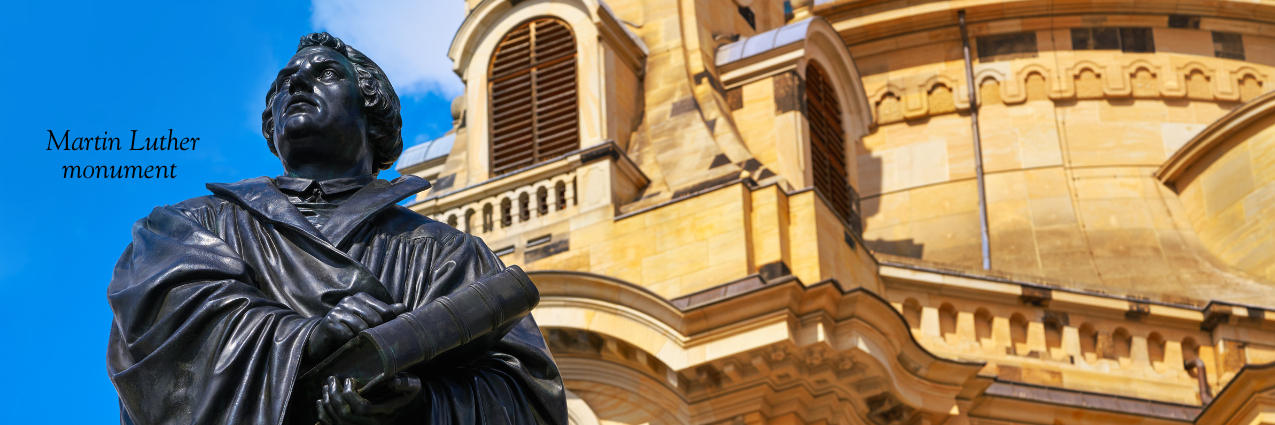
This week, we celebrate something that happened five hundred years ago called the Protestant Reformation. This is when a man named Martin Luther did something very brave on October 31, 1517. Martin Luther was a Christian. But he was very worried about wanting to follow all of the church’s rules.
When he was younger, he was a Catholic monk. He became a monk because one night he was so frightened by a thunderstorm, that he promised if he was made safe, that he would become a monk. At that time Martin Luther was a very serious, obedient person who always tried his best to follow every single rule in his church. He wanted to pray the right way, think the right things, and do everything right. In fact, he was so careful about following the rules that he would get really nervous if he thought he’d missed one. Sometimes he worried so much that it made him sick to his stomach.
But Luther started noticing things in the church that felt wrong. One big thing he noticed was that the church was asking people to pay money to help them be forgiven for their mistakes, or “sins.” This payment was called an indulgence. The church taught people that by paying indulgences, they could be forgiven and become closer to God. Luther didn’t think that was right so he dug into studying the book of Romans.
Luther was sensing that the Church’s teaching was not lining up with what the Bible actually taught. He began to believe that forgiveness wasn’t something people should have to earn or buy. That is when he wrote down 95 Theses. These were 95 problems he had with the church and he nailed them to a church door in Wittenberg, Germany on “All Hallow’s Eve”, or (Halloween), or the eve of All Saints Day. This was like posting a big message for everyone to see. It was bold and it was a bit dangerous to do back then.
Martin Luther had read a Bible verse that changed his life. It was from the book of Romans, and it says: “For in it the righteousness of God is revealed from faith for faith, as it is written, “The righteous shall live by faith.” After reading this, Luther felt that being close to God—being “right” with Him—wasn’t about paying money or doing a list of special things; it was about faith. And other parts of the Bible show the faith is not earned, it is a gift from God.
Luther understood that people couldn’t become right with God just by paying money or even by always following rules perfectly. And if they could, then why would God’s son die on a cross? The church was teaching people that they needed to do the right things all the time to be in a good relationship with God. But Luther realized that it was actually Jesus who makes us right with God, and not anything we do on our own. Jesus paid for all our mistakes, or sins, and brought us close to God. That’s why Martin Luther believed that faith, trusting God, was the key to being right with Him.
So, in writing the 95 problems (called the 95 Theses), Luther was trying to help people understand that God’s love and forgiveness are free gifts. You don’t have to pay for them or do things perfectly; you just have to have faith in Jesus. This was a big change from what the church was teaching. Martin wanted people to know that Jesus loves them no matter what, and it’s faith in Jesus that brings them closer to God.
Even today, people can sometimes feel like they have to “earn” God’s love or be “good enough” for Him. But Martin Luther’s message reminds us of something very important: Jesus already did everything to make us right with God. God just wants us to trust in Him and love Him, not feel like we have to do everything perfectly.
So, every year on October 31 and November 1st, we remember Martin Luther and his bravery in standing up for what he believed was true. His actions changed how many people understand faith, love, and forgiveness. And that’s why Martin Luther is such an important person to remember in Christian history.
When I was in high school, I got in trouble pretty often, but it was usually for causing mischief. I loved pulling pranks and making people laugh. During my senior year, I pulled a big prank with my friend, Justin, that had a big impact on me. We decided to mess with the locks on people’s lockers right before the last day of school. We switched all the locks around, so people couldn’t open their lockers! It was total chaos as everyone struggled to get into their stuff.
Of course, we got caught and got into a lot of trouble, which we definitely deserved. If Martin Luther were around, he’d remind us that we’re supposed to be obedient and respectful to each other because we were made to live in God’s love. I had to learn this lesson pretty quickly, thanks to two people who helped me a lot at that time. One was my English teacher, Mrs. Dermond, and the other was the vice principal, Mr. Hoffman.
That day, I sat in the principal’s office with a lot of adults who were really mad at me. Up until then, I’d always thought that when I made a mistake, the only way to make things better was to do better next time, which sometimes felt impossible. Then, Mrs. Dermond took me into the hallway, gave me a hug, and said something like, “You are loved.” She reminded me that even though I’d messed up, I was still loved. And Mr. Hoffman, the person who had to give me my punishment, said something like, “You know this was wrong, right? It needs to be fixed, but it was funny. Remember, you are not just your mistakes.”
That kindness and forgiveness they showed me is called grace. It’s like what Martin Luther understood back in 1517 when he translated the book of Romans. Adults might tell you how you should dress, what to say or not to say, and how much of the Bible to memorize. And those things are good to know, but they aren’t what saves us or makes us loved by God.
Martin Luther saw a big problem: many people believed that they could almost be “good enough” on their own and just borrow a little help from Jesus when they needed it. It’s kind of like thinking you can pay for most things yourself with your allowance or babysitting money, but sometimes you just need to borrow a little more. Luther realized this isn’t really true.
In reality, we all have a huge debt we can’t pay ourselves. It’s not just about missing the mark a little—it’s that we are separated from God from the start and can’t fix it on our own. Some adults will have lots of rules about things like movies, clothes, or screen time, and while the Bible offers wisdom, it doesn’t make strict rules for everything. If being right with God was about following rules and borrowing a little extra from Jesus when we fall short, then Jesus wouldn’t have needed to pay our debt in full. Luther discovered that Jesus didn’t come to give us just a little help—He came to set us completely free. Our way back to God is to accept this gift of freedom, not to rely on following lots of rules.